City Guide · 10 min read
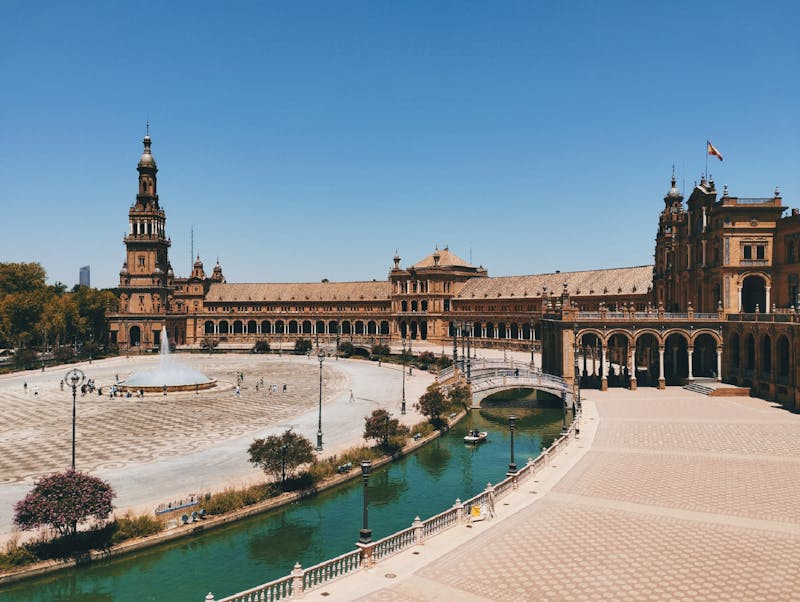
Most international buyers arrive in Andalucía with the coast in mind. Seville tends to come later — usually after a first visit, and usually with a slight sense of surprise. It is a different proposition entirely from Marbella or Estepona, and the differences matter far more than the shared postcode suggests.
This guide sets out what Seville is as a market, how its neighbourhoods differ, what buying really costs, and where the complications lie — the picture as it stands in 2026.
The single most useful thing to understand about Seville is that it is a real Andalusian city that happens to be beautiful, rather than a destination built around foreign visitors. It is the regional capital, with a university, courts, hospitals and a substantial services economy. Bakeries do not close in November. Neighbourhoods do not empty out in winter.
That has a practical consequence: foreign-buyer saturation is far lower here than on the Costa del Sol, where whole developments are effectively international enclaves, priced and marketed with overseas buyers in mind. In Seville you are buying into an ordinary Spanish housing market, alongside Spanish buyers — which is both the appeal and the difficulty.
Rental demand is correspondingly broader: sustained year-round tourism, a large student population, and genuine long-term tenant demand from people who work in the city. That mix is more resilient than a purely seasonal holiday-let market, though we would caution against assuming any particular return. Yields depend heavily on the specific property, the licensing position and how it is managed, and anyone quoting a confident percentage before seeing the property is guessing.
"The coast sells a lifestyle to outsiders. Seville sells you a place in a city that was already there. Both are valid — but they reward completely different kinds of buyer, and they carry completely different risks."
Seville's character changes sharply within a few hundred metres. These are the areas international buyers most often ask about, with the trade-offs stated plainly.
Three practical considerations cut across all of them. First, summer heat is a serious factor — orientation, insulation, shade and cooling are not afterthoughts in Seville. Second, patio and courtyard houses, the classic old-town format, behave very differently from an ordinary apartment: drainage, party walls, shared structures and light rights all need checking. Third, protected and listed status in the historic centre can restrict renovation, façade changes, window replacement and even interior alterations, and the licensing process is slower than most buyers expect. Parking is scarce and expensive across the centre, and is worth treating as a separate purchase decision.
Indicative asking prices for prime residential property in Seville sit at roughly €3,100 per square metre — a figure that is indicative, compiled from public local registries and published market sources, and not a valuation of any specific property. That is far below prime Marbella, and it is the main reason Seville reads as good value to buyers who have only looked at the coast.
Treat it as an orientation point, not a guide. Within the city, price per square metre varies widely by barrio, floor, condition, lift access and outdoor space.
The purchase price is not the purchase cost. In Andalucía the tax treatment depends on whether the property is a resale or a new build, and the difference is significant.
| Cost | Resale property | New-build |
|---|---|---|
| Transfer tax (ITP) | 7% (Andalucía) | N/A — not applicable |
| VAT (IVA) | N/A — not applicable | 10% |
| Stamp duty (AJD) | N/A | ~1.2% |
| Notary & land registry | Payable | Payable |
| Independent legal fees | 1–1.5% | 1–1.5% |
| Total all-in buying cost | ~12–14% | ~12–14% |
| 3% retention | Withheld from a non-resident seller | N/A |
| NIE number | ✓ Mandatory before completion | ✓ Mandatory before completion |
Two rows deserve a note. The 3% retention is regularly misrepresented as a buyer's tax. It is not: where the seller is non-resident, 3% of the price is withheld from the seller and paid to the Spanish tax authority against their potential capital gains — a seller-side obligation that the buyer administers. And the NIE is mandatory before completion for every buyer, so it belongs at the start of your timeline, not the end.
Budget around 12–14% on top of the price and you will not be caught out. We set this out in more detail in our breakdown of the true cost of buying in Spain. If you have seen alarming headlines about punitive levies on non-EU purchasers, the current factual position is covered in our explainer on the proposed 100% non-EU tax.
Seville is a market where independent representation earns its keep for concrete reasons rather than general reassurance. Most of the market is conducted in Spanish: listings, community minutes, planning correspondence, surveyors and notaries all work in Spanish, and much of the useful detail is never translated. A buyer working only in English sees a fraction of it.
The old-town stock also carries real complexity. Listed status, licensing history, tourist-rental permissions, shared structural elements, community obligations and unregistered alterations are all common, and none are visible in a photograph — a property can be lovely and still be a poor purchase because of what sits in its file. Remote buyers are at a particular disadvantage here: you cannot assess a patio house from photographs, not the damp, the noise, or the light at four in the afternoon in August. Someone has to stand in it on your behalf and tell you the unflattering parts.
"Our job in Seville is mostly to slow things down: read the file, walk the street at different hours, and give you the reasons not to buy. If a property survives that, it is probably a good one."
A few figures are worth having, correctly labelled. British buyers are the largest foreign nationality purchasing property in Spain. In 2025, foreigners bought a record 97,500 homes in Spain, equal to 13.82% of all sales. You will also see +14.3% year-on-year price growth quoted — that is a national figure from Tinsa, and it should never be presented as a Seville or Andalucía number. We mention it precisely because it is so often mislabelled.
Purchasing property in Spain no longer carries any residency entitlement. The Golden Visa was abolished on 3 April 2025, and buying is now fully decoupled from immigration status. You can own a home in Seville purely as an owner, with no visa attached. If you do want to live in Spain, the Non-Lucrative Visa and the Digital Nomad Visa both remain available and are assessed entirely separately from any property you own — we compare them in our guide to Spanish residency after the Golden Visa.
Seville rewards buyers who want a city rather than a resort, who are comfortable with older and more complicated housing stock, and who are buying for the place rather than a projected return. If that sounds like the right trade, the sensible sequence is straightforward: decide which barrio genuinely suits how you will use the property, budget 12–14% above the price, get the NIE moving early, and have someone independent read the legal file before you commit to anything.
Updated June 2026. Pricing and market figures are indicative and revised as sources are updated.
This article is general information and is not tax or legal advice. Confirm your specific position with a qualified Spanish lawyer and tax adviser before committing to a purchase.
Tell us how you'd actually use the property and we'll tell you honestly which barrios fit — and which to rule out. No obligation, no pressure.
Book a Free Consultation